

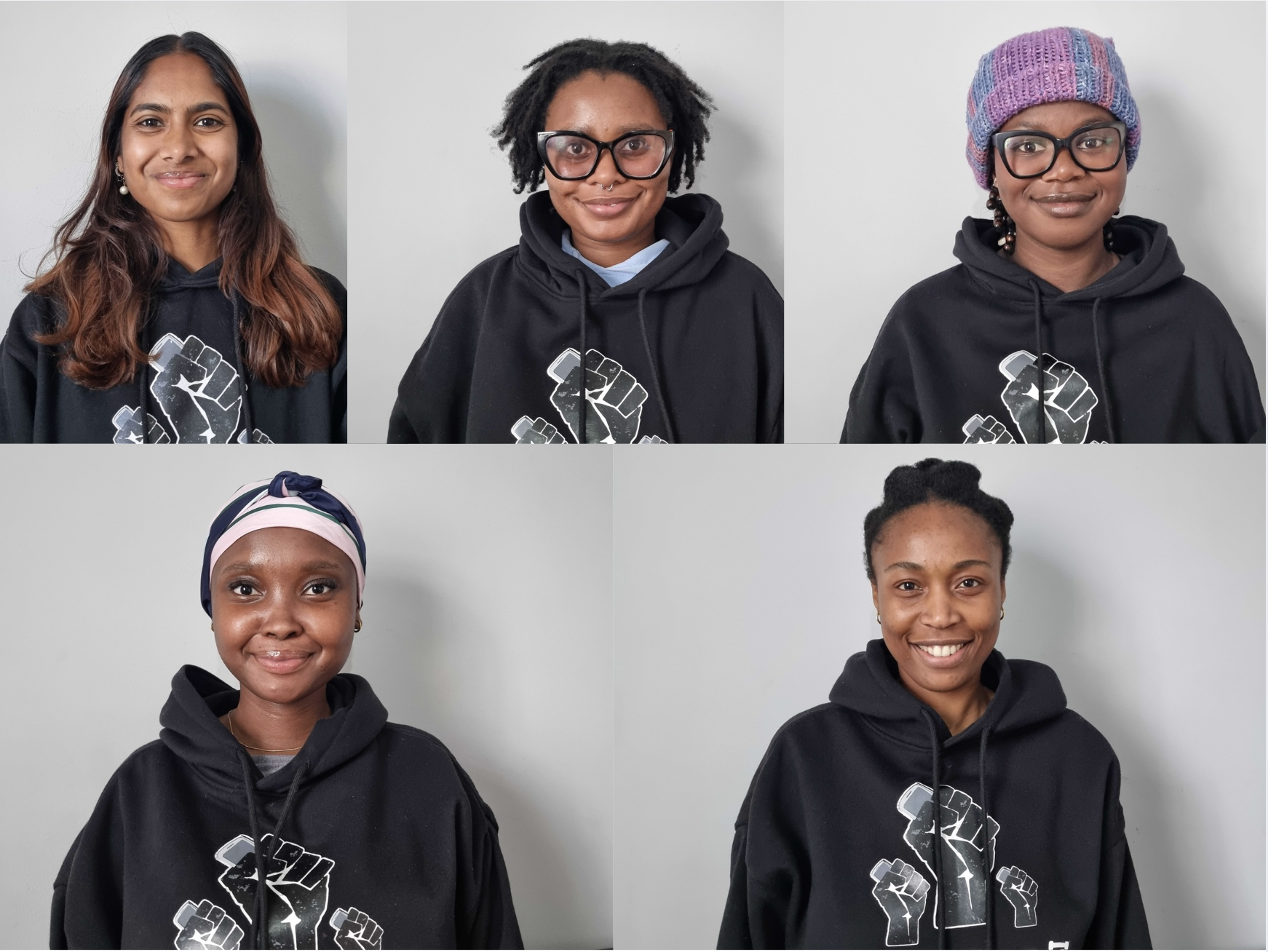
(From Top Left to Bottom Right) Deminkha Pillay, Kgaogelo Matlatle, Livhuwani Malelelo, Refiloe Ndzeku, Rotshidzwa Marole.
Deminkha Pillay
Deminkha is many things, they are an intersectional activist, a decolonial researcher, a multimodal creative, a sibling, a daughter, a student, a friend etc. Many of these things, they became in reaction to their belief for justice and connection rooted in empathy. They became a creative to create work that was both disruptive and healing, a researcher so that they could shed light on what was misrepresented, and an activist so that they could use their voice to challenge the systems of inequality. Discontent by the disconnect between academic theory and lived experience, Deminkha pivoted from academia to communications and community engagement, where they found that in an age of overconsumption and overwhelm, there is an evermore need for accessible, empowering, and safe spaces that recognise the complex and translate it into something that can be held. As a Campaigner Fellow at amandla.mobi, they have learnt the real power of messaging, discovered how much power people can actually hold, and found a community of people who are not only phenomenal but also genuinely care and give them hope that a more loving society is and will be possible.
Kgaogelo Matlatle
Kgaogelo “Solomon” Matlatle is a rural woman weaving intersectional ecofeminism, memory, travel and care to reclaim belonging, practice mindfulness, and to offer a transformative framework for reclaiming public policy in South Africa and throughout the world, particularly across the critical pillars of climate justice, education, and gender equity. I imagine a world where Black women are free and safe, and where they are able to take part in the creation of policy.
Livhuwani Malelelo
Livhuwani is a gender justice activist and writer based in Johannesburg. Passionate about women’s rights, equality and feminism, Livhuwani’s work has appeared on Mail & Guardian, Migrant Women’s Press, Daily Maverick and others. Livhuwani has previously interned at SECTION27, was one of the literacy ambassadors at the World Literacy Foundation in 2024 and volunteers her time at Politics4Her as a communications officer. Inspired by stories from and about African women, she believes that storytelling can be a tool used to connect, initiate important conversations in our communities, as well as inspire the change we are so passionate about.
Refiloe Ndzeku
I am a mother deeply dedicated to my family, care work, and my community. I am inspired by St Jude, the patron saint of hope and impossible causes, and I believe that where others see despair, there is still sacred ground for hope. Through my time at amandla.mobi, I have learned that change does not begin with having all the answers. It begins with listening, asking better questions, understanding the systems that shape our lives and recognising the power people have when they come together. I have learned to see the experiences of ordinary people not as isolated struggles, but as stories that can reveal what needs to change and give us the courage to demand something better. I believe a better, safer, and more beautiful world is not a distant fantasy, but something we must dare to imagine together, speak into existence, and build with our own hands. For me, care is more than an act of devotion. It is a living legacy, a radical gift of hope so that our children, and all children, inherit a world worthy of their dreams.
Rotshidzwa Marole
My name is Rotshidzwa, meaning “we are protected” or “we are sheltered.” I begin with my name because I believe protection is not simply about safeguarding people, but about creating the conditions in which human beings can live with dignity and realise their potential. My academic and professional interests are rooted in questions about South Africa’s constitutional project and its promise of transformation. I am interested in the contradiction between a constitutional democracy founded on addressing the inequalities of the past and the continued reproduction of profound social and economic inequality. In particular, I am interested in the gap between the formal recognition of rights and their substantive realisation in people’s lives.
This has led me to the capabilities approach to justice, particularly the work of Martha Nussbaum and Amartya Sen. I am interested in what it means to ask not simply whether people possess rights, but what they are actually able to do and to be. The capabilities approach has shaped my thinking about socio-economic rights and reparative justice, particularly the need to understand the social, economic and historical conditions that enable or constrain people’s freedoms. I am interested in how these ideas can contribute to a more substantive understanding of transformation in South Africa.